By Sameera Ahmed | November 2025
Globally, small and medium businesses make up about 90% of all companies, provide up to 70% of jobs, and contribute roughly half of global GDP.
Here in Africa, SMEs account for about 95% of businesses and nearly half of GDP. Yet many operate informally, under-resourced, or without the people systems to sustain growth.
In South Africa alone, around 3 million MSMEs support 13.4 million jobs, but formal small-business output fell by 7% in 2023. It’s a fragile growth engine that needs structure, not just survival instinct.
And that’s where people infrastructure comes in, not as bureaucracy, but as the system that keeps small businesses alive, adaptive, and scalable.
Because if strategy sets direction, capability determines speed.
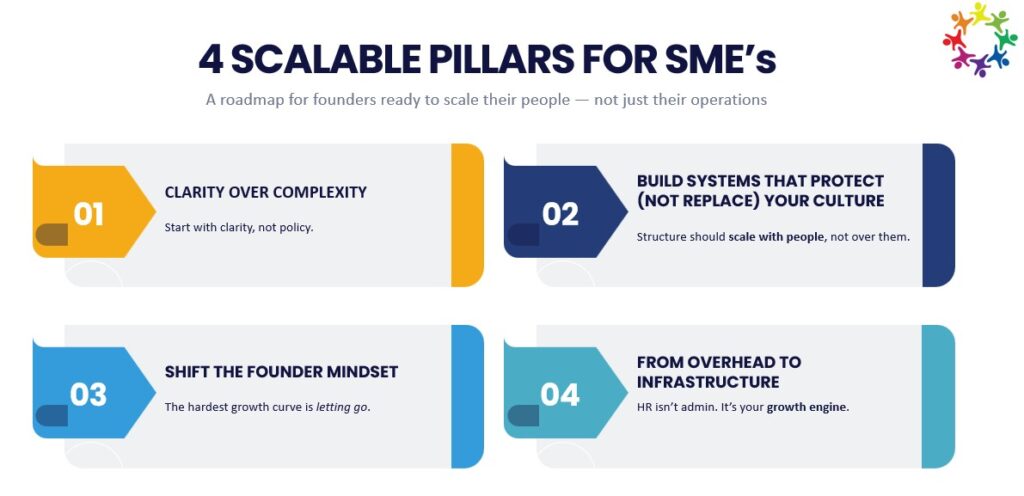
1. Clarity Before Complexity
Most small businesses only “fix HR” once the cracks appear. But the first step to sustainable growth isn’t policy. It’s clarity.
Start with a one-page People Operating Model that answers four simple questions:
- Who are we?
- What does success look like?
- How do we hire, onboard, manage, and reward?
- What rhythms help us stay aligned?
Businesses that establish a consistent rhythm of reviews, reflection, and recognition early on are the ones that survive volatility and grow through it.
Clarity doesn’t slow you down, it gives everyone the same map.
Clarity is the real infrastructure.
2. Build Systems That Protect (Not Replace) Your Culture
Structure should scale with people, not over them.
Too much process too early suffocates innovation; too little creates chaos.
The sweet spot is to define what’s non-negotiable. Fairness, communication, feedback, and decision rights – while leaving room for flexibility and evolution.
When your team co-creates the way things are done, structure becomes something they own, not something done to them.
That’s how systems anchor belonging instead of bureaucracy.
The moment your systems feel colder than your purpose – you’ve gone too far.
3. Shift the Founder Mindset
One of the hardest growth curves for any entrepreneur is letting go.
Globally, 64% of small-business owners say delegation is their weakest skill, yet founders who delegate effectively grow three times faster.
Early success often relies on the founder’s drive, but that same drive can become the bottleneck.
As the business matures, the founder’s role must shift from doing to deciding, and from managing tasks to developing people.
The best founders I’ve worked with don’t just build businesses, they build leaders.
They understand that when they stop being the hero and start building other heroes, their organisation scales naturally.
If everything still runs through you, you’re the system’s biggest bottleneck.
4. From Overhead to Infrastructure
HR isn’t admin. It’s your growth engine.
Every people decision has a financial consequence:
- Faster onboarding → revenue sooner
- Engaged teams → lower turnover
- Clear performance rhythms → higher productivity
When you link people strategy directly to capability and cash flow, HR stops being a cost centre and becomes infrastructure for growth.
But that infrastructure must evolve, because the future isn’t job-based; it’s skills-based.
The Future Is Skills-First
Globally, the world is moving from roles to skills ecosystems.
By 2030, 85 million jobs could go unfilled due to a lack of skills, yet many capable people remain under-utilised because their talent is locked inside rigid job descriptions.
For SMEs, agility is survival. The future of scaling lies in building mobile, skills-based teams that blend permanent employees, project specialists, freelancers, and alumni talent.
Think of them as agile skills squads, flexible groups that form around business priorities, deliver outcomes, then redeploy.
It’s how small businesses can stay nimble while building deep capability.
Practical ways to start:
- Create a living skills map – know what expertise you have and where the gaps are.
- Build internal gigs or short-term projects where employees can stretch beyond their job descriptions.
- Integrate freelancers and consultants as part of your ecosystem, not outsiders.
- Recognise that learning agility is your most valuable skill – because skills expire, but curiosity compounds.
Stop hiring to fill a role. Start hiring to build capacity.
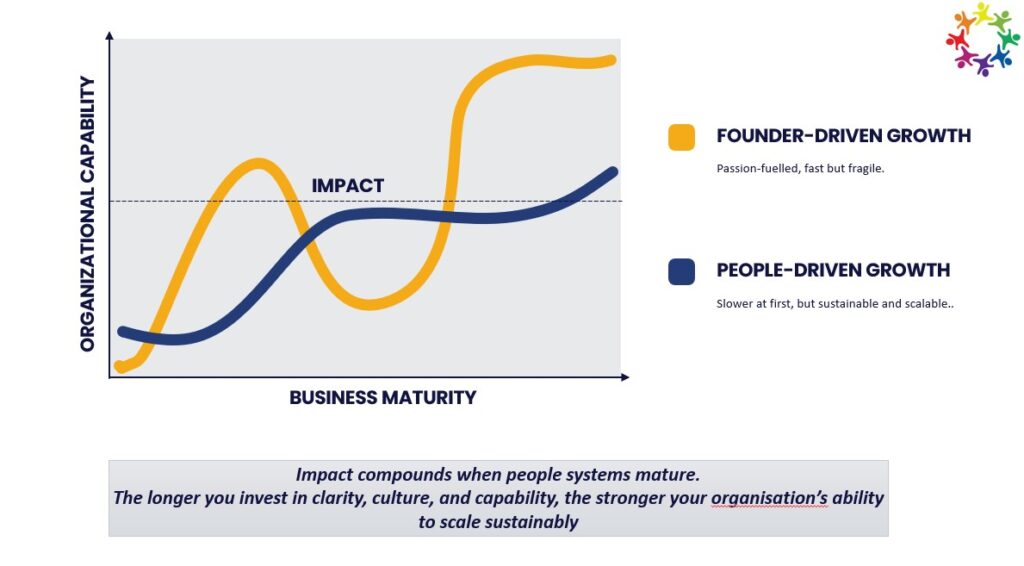
The Scaling Curve: From Reactive to Intentional Growth
Small businesses often grow in waves.
Early on, founder-driven growth brings quick wins but can be fragile.
Over time, people-driven growth – powered by systems, clarity, and culture — compounds into sustainable impact.
Across the growth curve:
- Start-Up: Passion and improvisation drive results but strain people.
- Growth: Chaos increases; clarity and structure are needed.
- Stabilisation: Delegation and rhythm bring alignment.
- Scale-Up: Capability multiplies; impact becomes consistent.
Impact compounds when people systems mature.
Closing Thought
Around the world, sustainable growth will depend not only on access to capital – but on people readiness:
the systems, skills, and leadership that turn ambition into execution.
Whether in Johannesburg, Jakarta, or Geneva, every organisation that invests in its people infrastructure is investing in innovation, inclusion, and long-term resilience.
The next era of business growth won’t be powered by headcount, it will be powered by connection, clarity, and capability.