
By Sameera Ahmed | February 2026
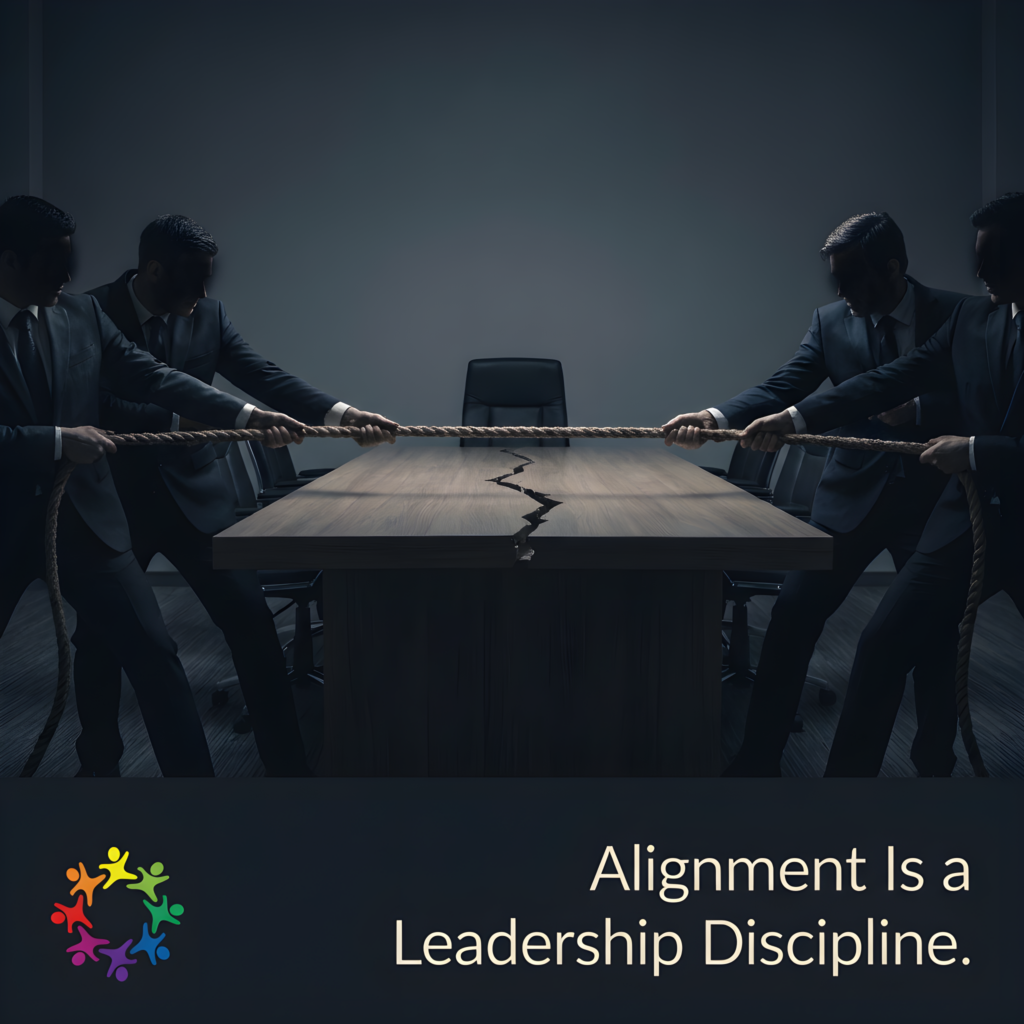
Organisations rarely admit this.
When culture begins to erode, the diagnosis is almost always directed downward:
- “Employees are disengaged.”
- “There’s resistance to change.”
- “Middle management isn’t driving accountability.”
- “We need a culture intervention.”
But culture does not fracture at the bottom. It fractures at the top.
Employees do not wake up and decide to destabilise an organisation’s culture. They respond to the signals they receive from leadership, especially the executive team.
And the most destabilising signal of all is visible misalignment.
The Myth of Cultural Decline
When organisations describe cultural decline, what they are usually observing are symptoms:
- Inconsistent standards
- Conflicting priorities
- Decision paralysis
- Political behaviour
- Reduced trust
These are not workforce problems. They are alignment problems.
Culture is not an initiative. It is an output.
It reflects how power is exercised, how decisions are made, and whether leadership operates as a coherent unit.
Disagreement Is Not the Enemy
Executive disagreement is healthy. In fact, it is necessary.
Strong leadership teams debate. They challenge assumptions. They stress-test strategy. They interrogate risk. But this belongs behind closed doors.
Once the executive team steps in front of the organisation, alignment is non-negotiable.
Not because everyone thinks the same. But because everyone has committed to the same outcome.
When leaders publicly contradict each other, reinterpret strategy independently, or apply standards inconsistently, the organisation does not see “healthy debate.”
It sees uncertainty. And uncertainty erodes trust faster than any policy failure.
How Misalignment Fractures the Value Chain
Visible executive misalignment does not stay contained. It cascades.
When leaders pull in different directions:
- The value chain fragments.
- Middle management hesitates and chooses sides.
- Accountability becomes selective.
- Performance standards weaken.
- Functional silos harden.
Over time, culture begins to drift.
And eventually, HR is asked to “fix it.”
But culture cannot be repaired through engagement surveys, workshops, or refreshed values statements if executive coherence is absent.
No amount of internal messaging can compensate for structural misalignment at the top.
Culture Is a Leadership Discipline
Culture stabilises when:
- Strategy is clearly defined and consistently reinforced.
- Decision rights are understood and respected.
- Governance standards are applied evenly.
- Leaders hold each other accountable privately and present unity publicly.
This requires maturity. It requires restraint.
It requires leaders who understand that once a decision is made, collective ownership matters more than individual preference.
Alignment is not cosmetic unity.
It is disciplined commitment to a shared goal and a unified value chain.
The Uncomfortable Truth
If your organisation is experiencing cultural drift, disengagement, or political tension, the first place to look is not the workforce. It is the executive table.
Culture does not collapse because employees disengage.
Employees disengage because leadership coherence weakens. Alignment is not optional.
Unity is not symbolic.
Culture is the outcome