
By Sameera Ahmed | December 2025
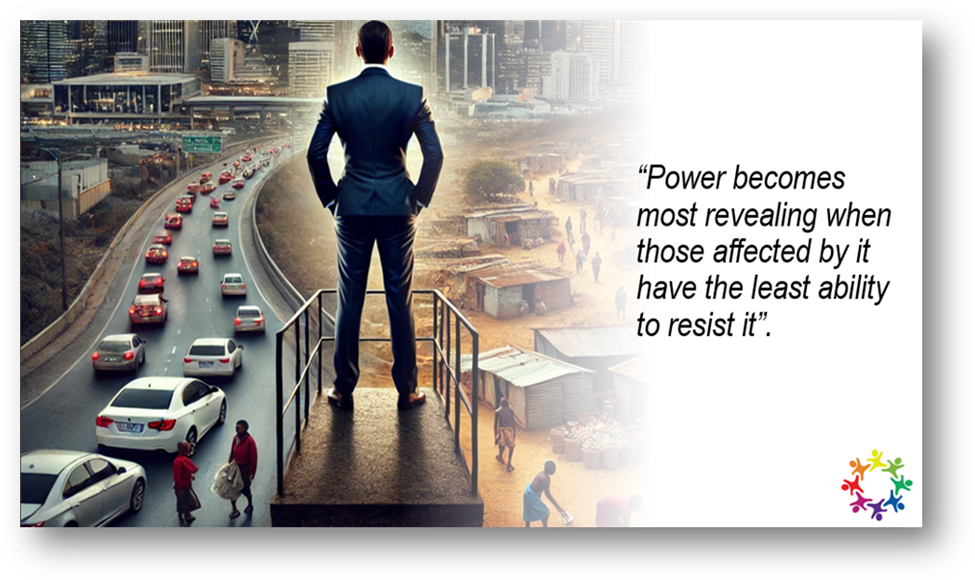
As the year closes, it’s worth asking not just what decisions were made – but who carried their cost.
Ethical leadership is not tested when business is easy.
It is tested when margins tighten, targets are missed, and decisions carry real human consequence.
In those moments, many organisations default to what is legally possible rather than what is ethically conscious.
This is where the Stewardship of Power matters.
What Is the Stewardship of Power?
The Stewardship of Power is a leadership principle that frames authority not as ownership, but as responsibility.
It recognises that leaders hold disproportionate influence over:
- People’s livelihoods
- Psychological safety
- Economic stability
- Organisational culture
Stewardship requires leaders to exercise power with restraint, discernment, and moral awareness – particularly when others have limited ability to push back.
This understanding is deeply rooted in African leadership traditions, where authority has always been tied to service, accountability, and the wellbeing of the collective.
Where the Stewardship Principle Comes From
The Stewardship of Power is not a borrowed academic model.
It is grounded in:
- African leadership philosophy, where power is understood as custodianship
- Ubuntu ethics, which centre dignity, interdependence, and moral accountability
- Lived organisational reality, especially in South African workplaces shaped by inequality, power asymmetry, and economic pressure
This principle aligns with ethical, servant, and responsible leadership scholarship – but it is contextualised rather than imported. It names a tension many leaders experience daily: the space where legality, performance, and humanity intersect.
Why the Stewardship of Power Matters Now
In today’s workplace reality, business decisions are increasingly made at the cost of employees – not always because they are fair, but because employees do not have the same reserves to challenge them.
Organisations often have:
- Legal teams
- Financial buffers
- Procedural advantage
Employees often have:
- A salary that stops when they push back
- Limited access to legal support
- Families dependent on continuity
- Very little margin for risk
This imbalance matters – particularly in South Africa, where unemployment remains high and job security is fragile. Many employees comply not because they agree, but because resistance is too costly.
And this is where ethical consciousness must override technical legality.
Legality answers the question: Can we?
Stewardship asks the harder one: Should we — and how?
Predatory Power vs the Stewardship of Power
Not all leadership under pressure is unethical. But how power is used under pressure reveals whether leadership is conscious – or predatory.
Predatory power treats authority as entitlement rather than responsibility.
It shows up as:
- Using pressure as justification for harm
- Hiding behind legality to avoid accountability
- Making decisions about people, without engaging them
- Transferring organisational risk onto those least able to absorb it
- Prioritising speed, control, and optics over dignity
Predatory power does not require bad intent. It requires unexamined authority.
The Stewardship of Power, by contrast, treats authority as entrusted – not owned.
It shows up as:
- Acknowledging power asymmetry and acting consciously because of it
- Making hard decisions with transparency and care
- Consulting meaningfully, not performatively
- Designing safeguards for those most exposed to impact
- Balancing sustainability with human consequence
The ethical difference is simple but profound:
Predatory power asks:
“What are we allowed to do?”
Stewardship asks:
“What are we responsible for?”
A Closing Reflection
Profit can be rebuilt.
Trust is far harder to restore.
As leaders prepare for the year ahead, the challenge may not be louder decisions or faster restructures – but more conscious stewardship of power.
In the end, power becomes most revealing when those affected by it have the least ability to resist it.
And leadership that endures is defined not by dominance – but by responsibility, restraint, and moral courage.