
By Sameera Ahmed | November 2025
✨ The Context
Africa stands at a defining moment.
By 2034, we’ll have the largest working-age population in the world — over 1.1 billion people ready to contribute, create, and lead.
Yet at the same time, we’re seeing an unprecedented talent drain.
Not just in the form of emigration — but in the quiet, daily loss of capable, ambitious people who outgrow the environments they’re in.
In our earlier article, Africa’s Workforce of the Future: Turning Youth Potential into Global Talent, we explored how Africa’s youth hold the key to the world’s next economic wave.
But potential alone doesn’t create prosperity. Opportunity does.
And opportunity is still too often the missing piece in our organisations.
💬 My Own Realisation
I once left a company I genuinely loved.
The culture was strong. The leaders cared. They invested in my learning.
But there came a point where I had nowhere to apply what I’d learned.
That was my turning point – the moment I realised that learning without opportunity is a slow exit strategy.
Many African professionals face the same crossroad. They don’t leave because they’re disengaged. They leave because they’ve stopped growing.
When Companies Don’t Invest, People Will. Just Not Always With You
Too many organisations still see development as a cost, not a catalyst.
They worry that if they invest in people, those people might leave.
The truth is – if they don’t invest, people will still grow… just without them.
I know someone who spent hundreds of thousands of rands on an MBA after their company refused to fund it.
They studied nights and weekends, graduated with distinction, and are now thriving — somewhere else.
That story isn’t rare. Across the continent, professionals are self-funding their growth, not because they lack ambition, but because their employers lack vision.
When businesses won’t back people’s growth, those people will back themselves – and the market will gladly welcome them.
The irony?
In a continent bursting with potential, we’re not losing talent to other countries, we’re losing it to other mindsets.
The ones that believe learning is an investment, not an expense.
The LEAP Framework: Turning Learning into Loyalty
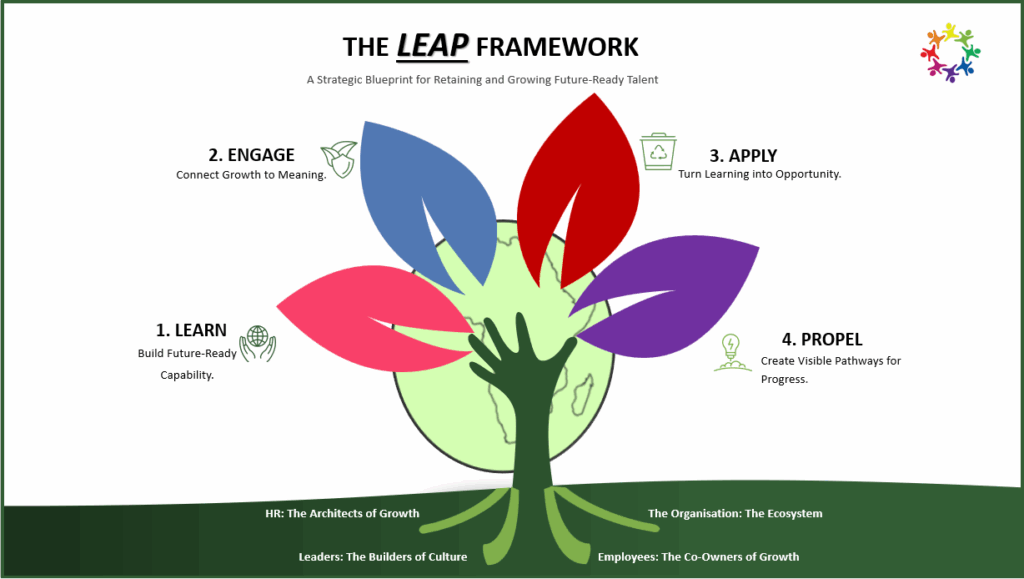
At Pinnacle HR, we’ve developed the LEAP Framework to help organisations transform growth into loyalty, and learning into leadership.
Because when people can see, feel, and apply their growth – they stay.
L – Learn: Build Future-Ready Capability
Learning is not an HR activity; it’s a strategic enabler.
The most successful organisations invest in skills that anticipate change – digital fluency, adaptive leadership, problem-solving, and human connection.
What this looks like:
- Building learning ecosystems aligned to your business strategy.
- Partnering with universities and youth accelerators to create early pipelines.
- Rewarding curiosity as a business behaviour.
Outcome: A workforce that’s agile, confident, and future-fit.
E – Engage: Connect Growth to Meaning
People don’t engage with policies – they engage with purpose.
When employees see how their development links to something bigger, loyalty grows organically.
What this looks like:
- Leaders who communicate vision and shared impact.
- Recognition that celebrates growth, not just output.
- Psychological safety to innovate, speak up, and challenge constructively.
Outcome: Employees who feel seen, safe, and significant.
A – Apply: Turn Learning into Opportunity
This is where many companies fall short.
They send people on training but fail to create roles or projects that allow for real-world application.
What this looks like:
- Cross-functional collaborations and problem-solving squads.
- Delegation of responsibility that stretches capability.
- Mentorship and coaching that transform theory into action.
Outcome: Learning that lives in the business, not in a binder.
P – Propel: Create Visible Pathways for Progress
People don’t stay where they feel stuck.
Propel your talent through clear career mobility, transparent promotions, and mentorship networks.
What this looks like:
- Internal job marketplaces and rotational programmes.
- Talent dashboards showing available growth opportunities.
- Leadership pipelines that prioritise inclusion and readiness.
Outcome: Growth that feels possible, visible, and worth committing to.
Who Owns Retention?
Retention isn’t HR’s burden. It’s a shared responsibility between HR, leaders, employees, and the organisation itself.
| Role | Primary Responsibility | Leadership Mindset |
|---|---|---|
| HR | Architect the systems and metrics for growth | Design the structure so people can thrive. |
| Leaders | Build the culture that enables opportunity | Delegate with trust and develop with purpose. |
| Employees | Activate their own learning and ownership | Own your growth — and share it generously. |
| Organisation | Sustain the ecosystem through alignment and reward | Make loyalty a design outcome, not a lucky one. |
The Mindset Shift
It’s time for African companies to move from:
❌ Protecting talent from visibility
to
✅ Creating environments where visibility, learning, and loyalty coexist.
When people LEAP – Learn, Engage, Apply, Propel – your business doesn’t just retain talent; it becomes a place that creates it.
🌍 The Bigger Picture
If Africa wants to stop the brain drain, it must start the growth chain.
That means building organisations that trust their people enough to grow, stretch, and shine – not hide them from opportunity.
Because the real question isn’t “What if we train them and they leave?”
It’s “What if we don’t, and they stay?”
When learning meets opportunity, loyalty follows.
And when loyalty deepens, Africa’s future strengthens.
#TalentRetention #FutureOfWork #LeadershipDevelopment #HRStrategy #AfricaRising #EmployeeExperience #PinnacleHR #LEAPFramework