
By Sameera Ahmed | Pinancle HR
“Often global articles ask: ‘How to include women of colour in leadership.’ I prefer asking: ‘What unique leadership gifts are women of colour already bringing that we haven’t leveraged enough?’”
Rethinking the Narrative
Too often, global leadership conversations focus on what’s missing: representation gaps, broken pipelines, or systemic inequities. Important, yes. But this lens can unintentionally frame women of colour as “deficits” to be fixed.
In reality, African women leaders are already innovating models of leadership that the world needs. Their ability to lead with resilience, community, and inclusive intelligence isn’t just admirable. It’s essential in today’s fractured, uncertain world.
The African Leadership Context
Africa’s leadership landscape is distinct, and that uniqueness creates lessons for the globe:
- Demographics: Africa has the world’s youngest population (median age 19). Leaders must bridge generational divides and lead youth-forward organisations.
- Diversity: South Africa alone has 11 official languages, layered with race, gender, class, and culture – requiring leaders to balance multiplicity daily.
- Volatility: Political shifts, economic inequality, infrastructure challenges and social unrest are constants – demanding leaders who are adaptive, resourceful and resilient.
For women of colour, these dynamics amplify the stakes. They are often the “first” or the “only” in boardrooms and must hold both corporate accountability and community trust simultaneously.
Case in Point: South Africa’s Boardrooms
Women now hold 35% of board seats in JSE Top 40 companies, yet only about 25% of executive roles, and women of colour make up an even smaller fraction.
And yet, those who do break through often embody leadership approaches that are deeply relational and transformational.
- Phuthi Mahanyele-Dabengwa, CEO of Naspers South Africa, has consistently spoken about community-rooted leadership and leveraging diversity as a source of innovation in Africa’s tech sector.
- Ngozi Okonjo-Iweala, WTO Director-General, exemplifies resilience – having navigated political turbulence in Nigeria while building credibility in global economic forums.
- Wangari Maathai, Nobel Laureate from Kenya, demonstrated the power of community-holding in mobilising grassroots women for environmental and political change.
These leaders show that African women are not just surviving tough conditions. They are forging leadership blueprints that global organisations can learn from.
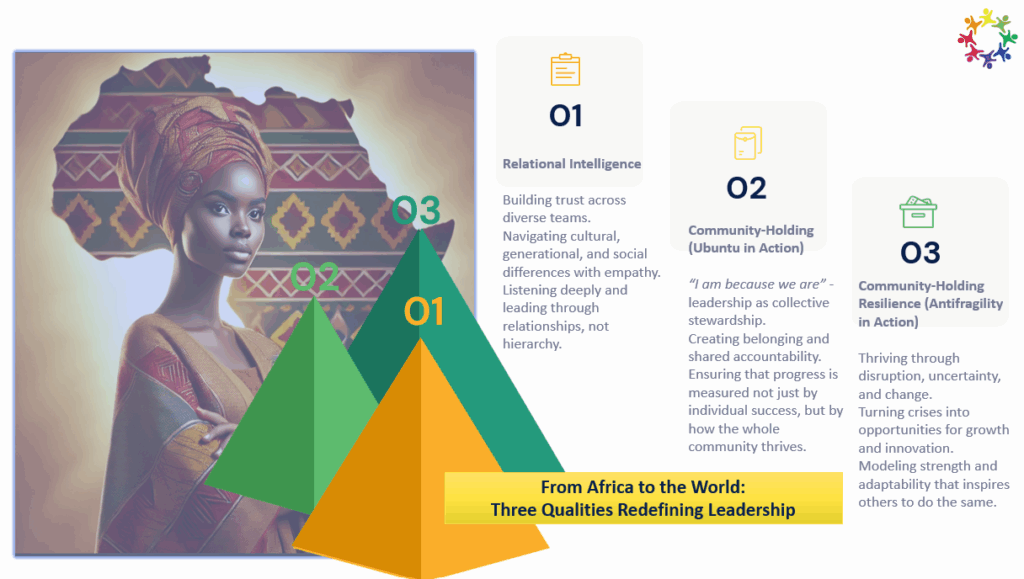
Three Qualities Africa Offers the World
1️⃣ Relational Intelligence
African leaders often lead across cultures, languages, and generations. Success comes from listening deeply, building trust, and negotiating nuance. Globally, where polarisation and mistrust are rising, relational intelligence is a desperately needed skill.
2️⃣ Community-Holding (Ubuntu in Action)
The African philosophy of Ubuntu – “I am because we are” – shapes leadership as collective stewardship, not individual status. This fosters belonging, shared accountability, and inclusive progress. For global organisations struggling with “quiet quitting” and disengagement, Ubuntu-style leadership offers a fresh way to build loyalty and meaning.
3️⃣ Navigating Complexity with Resilience
African women leaders operate in environments of uncertainty – political instability, social unrest, shifting economies. They have developed antifragility: the capacity not just to bounce back, but to grow stronger through disruption. Globally, as businesses face climate crises, digital disruption, and pandemics, this resilience is no longer optional.
Practical Lessons for Global Organisations
- Adopt “Ubuntu Circles”: Create cross-level forums where leaders listen, reflect, and problem-solve collectively, embedding inclusivity into daily decision-making.
- Build Relational KPIs: Measure leaders not only on results but also on inclusivity, psychological safety, and stakeholder trust.
- Institutionalise Sponsorship: Go beyond mentoring – ensure women of colour are given high-visibility assignments and that sponsors publicly advocate for them.
- Embed Resilience Debriefs: After crises or major projects, ask not only “what went wrong?” but “what made us stronger?”
What Africa Can Learn in Return
This isn’t a one-way street. African leaders can also adopt:
- Structured mentorship pipelines seen in North America.
- Radical transparency and accountability practices from Scandinavia.
- Scalable innovation frameworks from Asia.
The beauty of global leadership is reciprocity – learning flows both ways.
A Call to Conversation
👉 Which global leadership practice would you like to import into the African boardroom – or vice-versa?
It’s time to move beyond deficit-based narratives and recognise that women of colour — especially African women – are already bringing unique gifts to leadership. The world doesn’t just need to “include” them. It needs to learn from them.
#InclusiveLeadership #WomenOfColour #Africa #LeadershipDevelopment #Ubuntu #GlobalLeadership #WorldTradeOrganization #GreenBeltMovement