
By Sameera Ahmed | April 2026
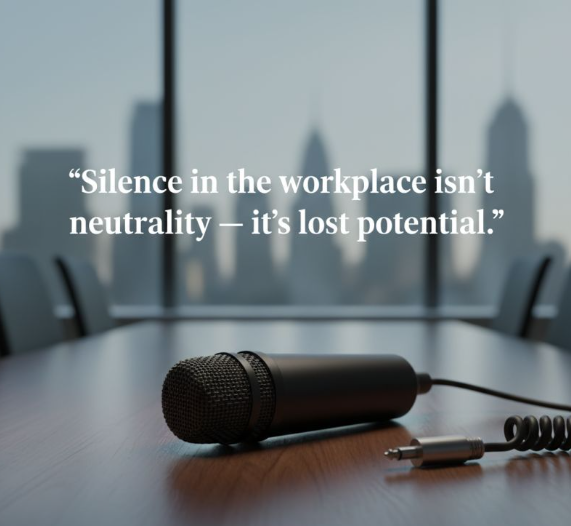
Leadership Has a Sound. And That’s the Problem.
Walk into most boardrooms and listen carefully.
Before a single strategy is tested…
Before performance is evaluated…
Something else is being assessed.
The voice.
Not consciously. But powerfully.
The Biology Is Real. The Bias Is Built.
Men and women do not have the same voices.
Testosterone thickens vocal cords during puberty, resulting in a lower pitch.
Estrogen results in shorter, thinner vocal cords and a higher pitch.
Lower-pitched voices are consistently perceived as:
- More authoritative
- More confident
- More “leader-like”
Higher-pitched voices are perceived as:
- More collaborative
- More empathetic
- Sometimes – unfairly – as less decisive
That’s biology. But leadership is not biology.
Leadership is a social construct shaped by what we reward. For decades, we have rewarded what sounds like authority.
What Happens in the Room
This is where it becomes operational, not theoretical.
In meetings across organisations:
- Women are interrupted more frequently
- Ideas are often validated only once repeated by someone else
- Speaking time is uneven
- Authority is questioned more subtly—but consistently
It’s not always overt.
It’s behavioural.
It’s patterned.
And it’s measurable.
Research shows women are up to 33% more likely to be interrupted in meetings, and in some environments, they are interrupted in as many as half of all interactions.
Men, on average, still dominate around 75% of speaking time in group discussions.
This is not a participation issue.
It is a listening issue.
Now layer in race.
Leaders of colour face an additional dynamic:
- Direct communication can be labelled as “aggressive”
- Assertiveness can be penalised rather than rewarded
- Tone is more heavily scrutinised
- Accent and delivery influence perceived credibility
So what happens?
Leaders – particularly women and people of colour – begin to self-regulate excessively:
- Am I too strong?
- Am I too soft?
- Am I saying this the “right” way?
That cognitive load is invisible. But it comes at a cost to leadership effectiveness.
And when they do contribute?
Nearly 4 in 10 women report having their ideas taken or credited to others, and they are less likely to receive recognition for their contributions.
The South African Reality: This Is Not Just Cultural. It’s Structural.
In South Africa, this conversation cannot sit in isolation from transformation.
Frameworks like the Employment Equity Act and Broad-Based Black Economic Empowerment are designed to:
- Increase representation
- Correct historical imbalances
- Create access to leadership
But here’s the uncomfortable truth:
👉 Representation without inclusion does not shift power.
You can meet your EE targets.
You can improve your B-BBEE scorecard.
And still have:
- Voices being ignored in meetings
- Leaders being second-guessed
- Contributions being diluted or redirected
Because the system of listening has not changed.
The Risk Most Organisations Are Missing
When voice bias exists, organisations:
- Misidentify leadership potential
- Overvalue confidence signals over competence
- Silence diverse thinking
- Create disengagement at leadership level
And ultimately:
👉 You weaken decision-making quality.
This is no longer a “soft” issue.
It is a leadership risk and a governance issue.
Leadership Is Not a Sound. It’s an Outcome.
The most effective leaders today do not:
- Dominate airtime
- Rely on vocal authority
- Or overpower rooms
They:
- Create clarity in complexity
- Hold tension without escalating it
- Enable contribution from others
- Influence outcomes—not just conversations
And none of that is determined by pitch.
What Needs to Shift
If organisations are serious about transformation and performance, this is the work:
1. Redefine what authority looks and sounds like
Move beyond historical associations of leadership with dominance.
2. Interrupt the interruption pattern
Make facilitation a leadership capability, not a meeting afterthought.
3. Measure voice equity
Who speaks? Who is heard? Who is credited?
4. Develop leaders to manage presence—not just content
Executive presence is not about sounding a certain way. It’s about intentionality under pressure.
5. Align inclusion with accountability
EE and B-BBEE are not compliance exercises. They are leadership system interventions.
The Leadership Question We Should Be Asking
Not:
“Who sounds like a leader?”
But:
“Whose voice is shaping decisions?”
Because until we shift that, we will continue to appoint diverse leaders,
but not fully hear them,
and mistake familiarity for capability.
Final Thought
We are not losing female leaders because they lack capability.
We are losing them because we are still misreading what leadership sounds like.
You can change representation.
But if voice, influence, and recognition remain unequal – then power hasn’t shifted. It’s just been rearranged.
The future of leadership will not sound one way.
And the organisations that understand this will not only be more inclusive, they will be more effective.
#Leadership #EmploymentEquity #BBBEE #Inclusion #WomenInLeadership #ExecutivePresence #OrganisationalCulture #SouthAfrica #FutureOfWork