
By Sameera Ahmed | November 2025
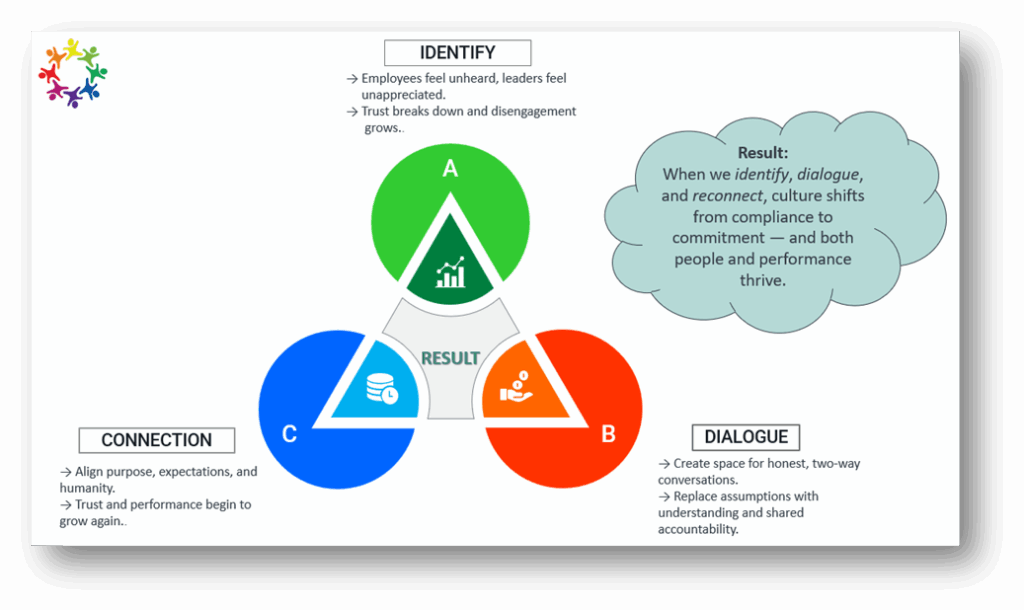
In boardrooms, on factory floors, and across virtual meeting screens, a quiet tension is rising.
Employees are disengaged because they feel unheard.
Employers are frustrated because they feel unappreciated.
Both sides are exhausted – and both feel justified.
We’re at a global crossroads where culture and life collide. People want to grow, but they also need safety, trust, and belonging before they can fully commit. Organisations want performance, innovation, and loyalty – but often expect it without giving the same in return.
And in between those unmet needs sits the silence – the kind that slowly erodes connection, motivation, and trust.
The Hidden Cost of Disengagement
That silence has a staggering financial cost:
- Gallup estimates that disengaged employees cost the global economy $8.8 trillion in lost productivity – about 9% of global GDP.
- McKinsey found that for a median S&P 500 company, the cost of attrition and disengagement equates to $228-355 million annually.
But beyond the numbers, there’s a quieter cost:
- Lost trust
- Leadership fatigue
- Declining innovation
- The slow death of purpose
Employees stop speaking up. Managers stop listening. Teams stop believing.
And that’s when culture, once proudly printed on walls, begins to hollow out from within.
When Trust Is Low, Both Sides Freeze
When trust is broken, both sides retreat.
Employees withdraw, protecting themselves from disappointment.
Employers tighten control, protecting themselves from risk.
It’s a stalemate that no one can afford.
The only way forward is to rebuild micro-trust. One small, deliberate conversation at a time.
Practical Steps to Rebuild Connection
For Employees
- Clarify your truth: Identify what you need: Clarity, recognition, flexibility, and why it matters to your ability to perform.
- Choose your moment: Request a short, focused conversation: “I’d like to share what I need to deliver my best.”
- Frame with collaboration: Replace blame with partnership. “Here’s what I need to succeed” is more powerful than “You don’t support me.”
- Offer solutions: Bring a proposal, however small, it signals ownership, not entitlement.
- Acknowledge effort: When leaders listen or act, recognise it. Gratitude builds relational currency.
For Employers & Leaders
- Initiate the conversation: Don’t wait for feedback. Invite it. “What do you need from me to succeed this quarter?” is a powerful start.
- Listen with structure: Five minutes to listen, two to reflect back, three to agree on one small action. Consistency matters more than length.
- Follow through visibly: Trust is built in the follow-up. Do one thing you promised, and communicate it.
- Be transparent about limits: Honesty about what can’t be changed builds credibility faster than vague promises.
- Model vulnerability: Admit when you don’t have all the answers. It opens the door for dialogue rather than defensiveness.
For Both Sides
- Create a Communication Charter: A shared agreement that defines how issues are raised, how feedback is handled, and what “respect” looks like in action.
- Start with quick wins: Choose one low-effort, high-impact change (clearer priorities, feedback loops, or recognition rituals) and trial it for 30 days.
- Use dual-agenda meetings: Dedicate time for both perspectives. What the business needs and what employees need to thrive.
- Track and celebrate progress: Even small shifts in trust or engagement deserve recognition, it reinforces that change is possible.
The Conversation We’re Not Having
The real question isn’t whether employees are loyal enough, or whether leaders are empathetic enough.
It’s whether both are listening enough.
Because silence has a cost, and connection has a return.
And in a world where burnout and disengagement are rising faster than profits, we can’t afford to treat trust as optional.
When we rebuild the space for conversation – honest, empathetic, and reciprocal – performance follows naturally.
✨ Growth will always follow when understanding leads.