
The Leadership Journey: From Control to Legacy How Leaders Grow, Evolve, and Transform Workplaces
By Sameera Ahmed | April 2025
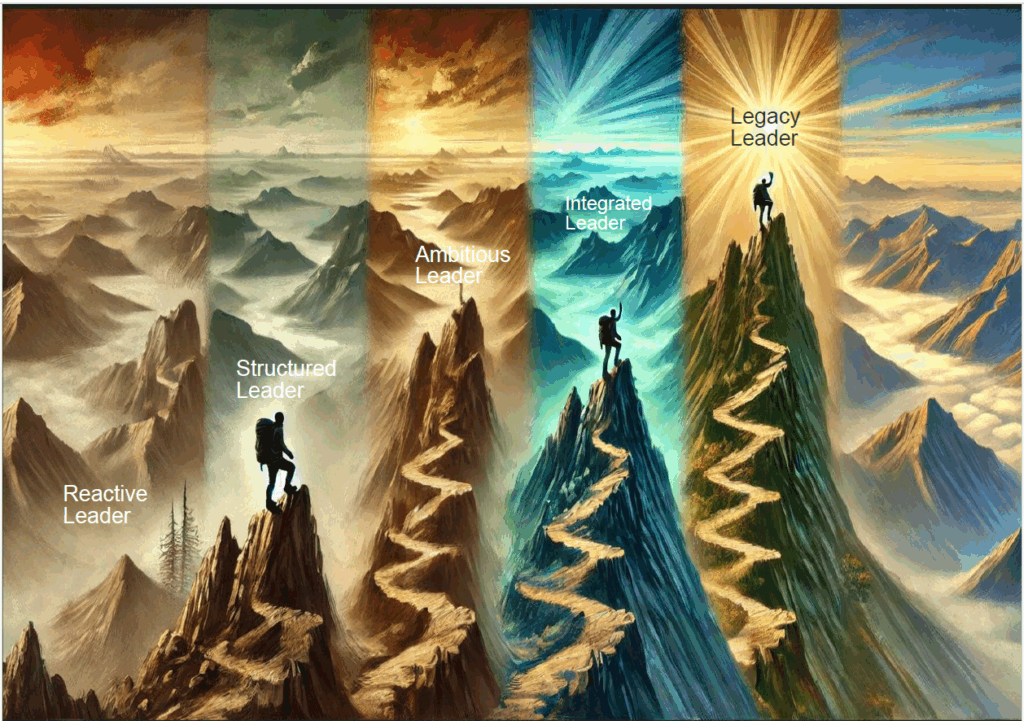
Leadership is not a destination or a title—it’s a journey marked by internal shifts, behavioral patterns, and the courage to evolve. True leadership maturity comes not from years of service alone, but from the depth of experience, quality of feedback, and readiness to grow through discomfort.
Every leader walks a path that can be shaped by their environment, the teams they lead, and their self-awareness. Understanding where you are on this path—and how to move forward—can transform not only your impact, but the culture of your workplace.
This article explores five developmental stages of leadership, the typical behaviors seen at each, how to recognize them in yourself or others, and what it takes to grow to the next level.
🔹 Stage 1: The Reactive Leader – Leading for Approval or Control
Common Traits
- Seeks validation from superiors and peers
- Avoids conflict or hard conversations
- Hesitates in decision-making
- May micromanage to feel in control
Influence of Team Level: Often leads junior staff; rarely challenged on thinking
Growth Opportunity:
Leaders at this stage must build confidence in their own voice, learn to receive and apply feedback, and begin trusting their intuition. It’s about transitioning from “needing to be liked” to “being willing to lead.”
Milestone to Next Stage:
- Begins making independent decisions
- Handles conflict with calm assertiveness
- Starts setting clear expectations and boundaries
For Teams:
Offer clear, respectful feedback. Reinforce strengths while advocating for clarity and direction.
🔹 Stage 2: The Structured Leader – Leading for Control and Efficiency
Common Traits
- Focused on rules, systems, and execution
- Metrics-driven and operationally strong
- Struggles with ambiguity or experimentation
- May resist feedback or change
Influence of Team Level: Often leads technical or operational teams, where efficiency is valued over creativity
Growth Opportunity:
The key here is to shift from control to collaboration. Leaders need to learn the value of flexibility, trust, and empowerment, and start to prioritize outcomes over rigid processes.
Milestone to Next Stage:
- Starts delegating strategically
- Welcomes feedback and diverse thinking
- Begins to lead cross-functional or collaborative efforts
For Teams:
Show how adaptability can enhance performance. Offer solutions rather than problems and frame ideas within their logic-driven mindset.
🔹 Stage 3: The Ambitious Leader – Leading with Drive, Vision, and Ego
Common Traits
- Highly confident, charismatic, and goal-driven
- Wants recognition, influence, and career growth
- May overshadow others or take credit
- Can overlook team well-being in pursuit of results
Influence of Team Level: Often leads mid-level managers or project teams; success is defined by visibility and impact
Growth Opportunity:
This is a defining stage. Leaders must shift from ego to service, balancing ambition with humility. It’s about channeling vision into shared purpose and lifting others.
Milestone to Next Stage:
- Shares credit and creates space for others
- Prioritizes team growth over personal recognition
- Uses influence to inspire, not dominate
For Teams:
Support their strategic direction while gently holding them accountable to shared values. Use team wins as leverage to encourage collective recognition.
🔹 Stage 4: The Integrated Leader – Leading with Purpose and Emotional Intelligence
Common Traits
- Confident yet humble, consistent and calm
- Builds psychological safety and inclusive teams
- Coaches others and embraces feedback
- Balances vision with execution and long-term impact
Influence of Team Level: Leads senior or diverse teams, where trust, dialogue, and empowerment are key
Growth Opportunity:
Refinement and integration. Leaders here must nurture leadership in others, shape culture, and continue expanding their emotional agility.
Milestone to Next Stage:
- Begins succession planning and legacy work
- Invites feedback from all levels, including juniors
- Leads cultural transformation initiatives
For Teams:
Take initiative, ask for stretch opportunities, and offer feedback. These leaders thrive on co-creation.
🔹 Stage 5: The Legacy Leader – Leading for Impact, Mentorship, and the Future
Common Traits
- Grounded, visionary, and generous
- Develops future leaders and builds systems for sustainability
- Prioritizes long-term value over short-term wins
- Seen as a mentor, guide, or steward of culture
Influence of Team Level: Leads other leaders or entire organizations; focus is on societal or organizational impact
Growth Opportunity:
Staying open, curious, and relevant. Legacy leaders must avoid stagnation by learning from younger generations and staying close to evolving contexts.
Milestone of Maturity:
- Seen as a multiplier of talent
- Leaves behind a culture of empowerment
- Focused on legacy, not legacy-building
For Teams:
Engage deeply. These leaders welcome bold ideas and want to invest in people. Seek mentorship, share insights, and co-create the future.
These ranges aren’t linear or fixed. Some people spend 15 years in the reactive stage, while others accelerate through to integration within 5. Coaching, reflection, and exposure to stretch assignments can significantly speed up the process.
🌱 How to Accelerate Growth Between Stages
Growth between leadership stages isn’t automatic. It requires intention, feedback, and courage. Here’s how to fuel that evolution:
|
Transition |
Key Actions for Growth |
|
Reactive → Structured |
Build self-trust, seek feedback, take ownership |
|
Structured → Ambitious |
Loosen control, empower others, embrace ambiguity |
|
Ambitious → Integrated |
Manage ego, listen deeply, lead with values |
|
Integrated → Legacy |
Coach others, shape culture, elevate purpose |
🔍 Final Word: Leadership Is a Journey, Not a Destination
🔹 Influence of the Employee Level Being Led
The maturity and seniority of the team being led can absolutely impact a leader’s stage—both by highlighting their gaps and accelerating their development:
✅ Leading Junior/Entry-Level Teams
- May reinforce command-and-control behaviors, especially if employees lack experience or confidence to push back.
- Leaders are often seen as the sole authority, which can slow self-awareness if not challenged.
- Encourages short-term task management, less exposure to strategic thinking.
Leadership Risk: Getting stuck in transactional management and not developing coaching capacity.
✅ Leading Mid-Level or Cross-Functional Teams
- Requires greater emotional intelligence and collaboration.
- Exposes a leader’s ability to influence without authority, communicate vision, and navigate complexity.
- Feedback becomes more nuanced—leaders can’t rely on positional power alone.
Leadership Benefit: Helps transition from structured or ego-led leadership to integrated leadership.
✅ Leading Senior/High-Performing Talent
- Forces leaders to become mentors and facilitators rather than “doers” or “fixers.”
- Creates pressure to lead by influence, not direction—ego-based leadership tends to be rejected by confident, high-agency teams.
- Demands strategic clarity, humility, and adaptive thinking.
Leadership Growth Catalyst: Requires leaders to evolve quickly or risk being ineffective. This is where legacy leadership is forged.
Leadership maturity is shaped by three things:
- The complexity of the challenges you’ve led through.
- The level of talent and independence of the teams you’ve led.
- Your capacity for reflection, feedback, and growth.
Years of service matter—but they are not destiny. Some of the most impactful leaders are those who have led high-trust, high-talent teams early in their careers and who’ve had the courage to get feedback, course-correct, and evolve.
No leader is perfect, and no stage is inherently “better” than another. What matters is the awareness of where you are, the willingness to evolve, and the impact you have on others.
Whether you’re a new manager or a seasoned executive, leadership is a lifelong practice. And for every leader, there’s always a next level—one that asks not for perfection, but for growth.
Because the best leaders don’t lead to be followed. They lead to make others rise.
Steps for Reflection
Leadership growth starts with self-awareness — and that means looking inward before looking outward.
Here’s a simple process to guide your reflection:
- Look honestly at yourself.
Ask: “How am I showing up right now?”
Focus on your own behaviors, mindsets, and reactions — not how others are acting. This grounds your reflection in self-responsibility.
- Identify signals at your current stage.
Review the signs and behaviors from each leadership stage (Reactive, Structured, Ambitious, Integrated, Legacy).
Ask yourself:- “Which of these describe me when I’m at my best?”
- “Which show up when I’m under stress or challenge?”
- Reflect on triggers that move you between stages.
Leadership is fluid — we don’t stay in one stage all the time.
Think about:- What situations or environments pull you downward?
(e.g., feeling threatened, lack of trust, time pressure, unclear roles) - What conditions help you rise upward?
(e.g., psychological safety, clear purpose, confidence in your skills)
- What situations or environments pull you downward?
Write down the specific triggers that cause you to slip into old habits or move toward more mature leadership behaviors.
- Create your personal leadership continuum.
Draw a simple line:
Reactive → Structured → Ambitious → Integrated → Legacy
Mark where you usually operate — and where you tend to slip or advance depending on:
-
- Environment
- Psychological safety
- Your own abilities or sense of competence
- Perceived threats or stressors
- Notice patterns, not perfection.
Leadership growth is not a straight climb.
Some settings or relationships will challenge you to step back; others will help you stretch forward.
The goal is not to “never slip,” but to notice, recover, and realign.
- Set one small stretch goal.
Identify one behavior you can practice to move toward the next stage.
Example:- “When I feel criticized, instead of withdrawing, I will stay engaged and ask clarifying questions.”
Example of a Leadership Continuum in Action
“In team meetings, I notice I slip from Integrated back to Structured when the agenda goes off track — I start controlling the discussion. But when I’m mentoring others, I operate closer to Legacy, focusing on their development. My trigger is loss of control; my stretch goal is to stay open and collaborative even in messy conversations.”