
By Sameera Ahmed | August 2026
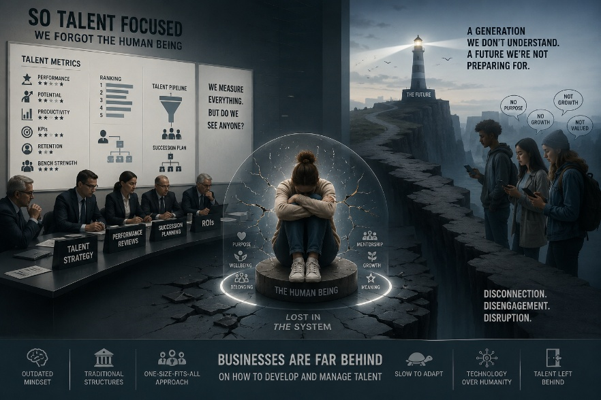
A year ago, I spoke at the IPM Conference about the war for talent.
We were talking about scarcity. Where will organisations find the skills they need? How do we attract great people? How do we retain them? How do we compete when everybody seems to be looking for the same increasingly scarce capabilities?
Lately, some of the most interesting conversations I have had about talent haven’t been with executives trying to find it.
They’ve been with talented people trying to understand why they aren’t allowed to move.
One person cannot apply for a promotion because they haven’t been in their current role for 24 months.
Another is effectively told that moving them would create too much risk. They are performing too well. They hold too much institutional knowledge. Senior leaders trust them.
“If you move, who will do what you do?”
Think about that for a moment.
We have somehow created environments where being exceptionally good at your job can become the very thing that prevents you from progressing.
The world of talent has changed
Organisations are talking about skills rather than jobs. Internal talent marketplaces. Career mobility. Skills-based workforce planning. Stretch experiences. Talent agility. AI-enabled work. Accelerated reskilling.
The traditional career ladder is becoming less relevant.
Careers increasingly look more like lattices: people move sideways, diagonally, into projects, across functions and sometimes into roles that didn’t exist a few years ago.
And yet, inside many organisations, our talent policies still assume a relatively predictable world.
Stay in the role for a prescribed period. Complete the required process. Wait for the next level. Wait for someone above you to move. Get another year of experience. Then perhaps you will be ready.
There is an increasingly uncomfortable gap between the agility businesses say they need and the rigidity with which we sometimes manage their people.
Time is not development
Let me be clear: governance matters.
Talent decisions need consistency. Fairness matters. Employment equity matters. We need to protect against favouritism and subjective decision-making.
But governance should enable good judgement.
It should not replace it.
An employee who has occupied a role for 5 years isn’t automatically more capable than one who has occupied it for 12 months.
Tenure tells us how long somebody has been sitting in a position. It doesn’t necessarily tell us what they have learned while sitting there.
Time is not development. Experience is.
The better question isn’t: “Have they completed 24 months?”
It is:“What evidence do we have that this person is ready for greater complexity, accountability or scope?”
And if the evidence says they are ready, perhaps our policies need enough flexibility to recognise that.
Then there is the high-performer trap
This may be the talent practice that concerns me most.
We tell people: Take ownership. Become the person we can rely on. Go beyond your role. Build relationships. Become indispensable.
And then they do. And suddenly we cannot afford to move them.
Because who will replace them? Who will the executive trust? Who knows the client? Who understands the system? Who will hold everything together?
So the organisation solves its succession problem by limiting the individual’s progression.
Your competence becomes your cage.
That isn’t talent management. It is dependency management.
If promoting one of your strongest employees creates an operational crisis, the problem isn’t their ambition.
The problem is that you have allowed critical capability to become concentrated in one person.
Where is the successor?
Where is the knowledge transfer?
Where is the bench strength?
Where is the development plan for the person underneath them?
And perhaps most importantly:
Why should an employee carry the consequences of an organisation’s failure to build succession?
This matters enormously for Africa
Across many sectors we already talk about scarce skills, leadership pipelines, technical capability shortages and the difficulty of finding experienced talent.
That makes every piece of talent we develop extraordinarily valuable.
Yet sometimes our response to scarcity is to hold talent tighter.
We protect the position instead of growing the person.
And that creates a vicious cycle.
We say we cannot promote someone because there is nobody ready to replace them.
But if we don’t move people, the people underneath them don’t get opportunities to stretch.
Without stretch, they don’t build experience.
Without experience, they aren’t considered ready.
And because nobody is ready, we cannot move the person above them.
We create the talent shortage we are trying to solve.
The experience paradox
There is another problem emerging.
Organisations want experience.
But someone has to create the environment in which people gain it.
We cannot continuously complain that emerging talent lacks experience while refusing to give emerging talent consequential work.
A course doesn’t create a leader.
A succession chart doesn’t create a successor.
A “high potential” label doesn’t create capability.
Experience creates experience.
- People need opportunities to make decisions.
- To lead something before they feel completely ready.
- To manage complexity.
- To fail safely.
- To recover.
- To work across functions.
- To solve unfamiliar problems.
- To be exposed to executives.
- To manage clients.
- To take on assignments slightly beyond their current capability.
That is how we shape talent.
Retention or containment?
Perhaps we also need to rethink what we mean when we say retention. Keeping someone in the organisation isn’t necessarily the same as retaining their commitment.
There is a difference between retaining talent and containing talent.
A person who stays because they can see themselves growing with you is retained.A person who stays because your structures prevent them from moving is contained.
The difference may not immediately appear on your turnover dashboard.
But it will eventually appear somewhere else.
In engagement.
In discretionary effort.
In innovation.
In psychological safety.
In the quality of your succession pipeline.
Or eventually, in a resignation letter.
And then we will sit around an executive table asking:
“Why are we losing our best people?”
Perhaps we should ask the question earlier.
Maybe the war for talent isn’t outside the organisation anymore
We still need to compete for scarce skills, but perhaps the next battle for talent is happening inside our organisations.
It is the tension between potential and policy.
Between agility and process.
Between development and dependency.
Between leaders who build successors and leaders who become dependent on their strongest people.
Between organisations that say they want high-potential talent and organisations prepared to create the conditions in which that talent can actually move.
Which leaves me with a few questions for HR leaders, executives and boards:
If someone is ready after 12 months, why must they wait 24?
If someone cannot be promoted because they are too valuable where they are, whose succession failure is that?
How many of our “not ready” employees simply haven’t been given the experiences that would make them ready?
Do our managers get rewarded for developing talent that moves out of their teams — or do we inadvertently reward them for holding onto it?
When did we last review our talent policies against the world of work we are operating in now, rather than the world in which those policies were written?
And perhaps the biggest one:
If your best people have to leave your organisation in order to grow, do you really have a retention problem?
Or do you have a talent-shaping problem?
A year ago, I was thinking about how organisations could win the war for talent.
Today, I think the question is different.
What are we doing with the talent once we have it?