
By Sameera Ahmed | September 2025
For years, HR has been labelled as the “people department” – responsible for hiring, payroll, and performance reviews. While those functions are important, they are not enough. In today’s world of fast-changing markets and competitive pressure, HR cannot afford to sit on the sidelines. To truly create impact, HR professionals need to understand the business they serve – its strategy, drivers of revenue, cost pressures, and growth ambitions – and then link people strategy directly to business results.
The Business of HR is the Business Itself
HR professionals who know their business context are better positioned to:
- Prioritise the right talent initiatives. Instead of implementing generic programs, they can focus on what will move the needle for the company — whether it’s building technical capability, reducing turnover in critical roles, or accelerating leadership bench strength.
- Speak the language of leaders. Executives care about revenue, margins, customer growth, and shareholder value. When HR connects initiatives like training, engagement, or workforce planning to these outcomes, they earn credibility at the decision-making table.
- Anticipate future challenges. Understanding market conditions, customer needs, and operational risks allows HR to proactively design workforce solutions before gaps become crises.
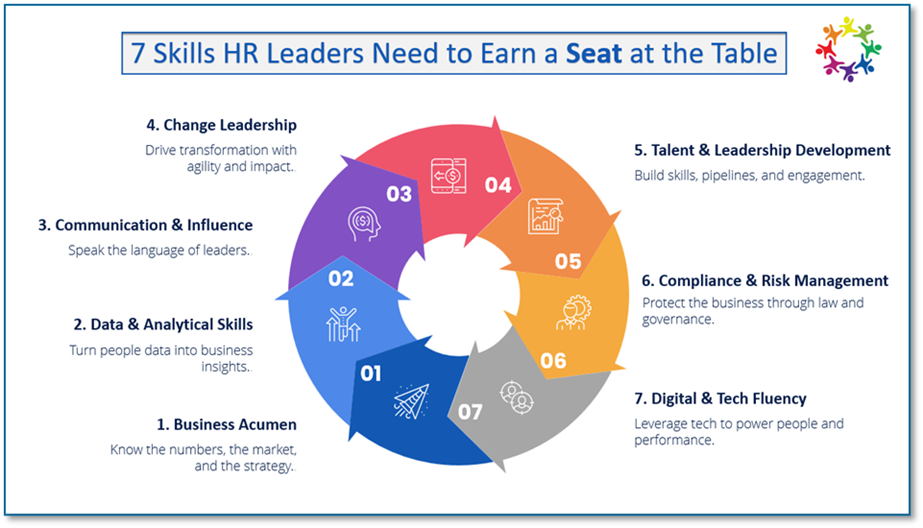
7 Skills HR Leaders Need to Earn a Seat at the Table
To shift from “support function” to “strategic partner,” HR professionals must build more than people expertise. They need seven critical skills that allow them to link people strategy to business performance:
1. Business Acumen
Great HR leaders don’t just know policies — they know profit. Business acumen means understanding how the company makes money, what drives costs, and what its long-term strategy looks like. With this knowledge, HR can ensure people initiatives directly support growth, competitiveness, and sustainability.
2. Data & Analytics
Gut feel isn’t enough. Today’s HR leaders must use data to track trends, predict risks, and demonstrate impact. From turnover patterns to productivity insights, HR analytics equips professionals to make evidence-based decisions and prove the ROI of talent investments.
3. Communication & Influence
Having great ideas is one thing. Getting leaders to act on them is another. HR must learn to “speak business” — framing recommendations in terms of revenue, efficiency, and shareholder value. Clear, confident communication earns trust and influence at the executive table.
4. Change Leadership
Businesses are constantly evolving — restructuring, digitising, expanding. HR must lead people through change by building resilience, addressing resistance, and keeping teams engaged. Strong change leadership ensures transformations succeed instead of stalling.
5. Talent & Leadership Development
A business is only as strong as its pipeline of leaders and skilled employees. HR must focus on building critical capabilities, designing career pathways, and ensuring succession planning is in place. The result: engaged employees today and strong leaders tomorrow.
6. Compliance & Risk Management
People risks are business risks. HR must protect the organisation by ensuring compliance with labour laws, maintaining governance, and embedding ethical practices. This skill isn’t just about avoiding penalties — it’s about safeguarding reputation and trust.
7. Digital & Tech Fluency
HR cannot stay manual while the business goes digital. Leaders must embrace HR tech, analytics platforms, and emerging tools like AI to improve efficiency and employee experience. Digital fluency allows HR to deliver faster, smarter, and more strategically.
Linking People Strategy to Business Results
At its core, people strategy is not about HR for HR’s sake. It’s about enabling the business to achieve its goals. Consider a few examples:
- Growth through innovation. If the business is targeting new product development, HR’s role is to build an environment where creativity thrives, cross-functional collaboration is seamless, and innovation is rewarded.
- Operational efficiency. If the strategy is cost leadership, HR can support through workforce optimisation, lean processes, and performance incentives that reward productivity.
- Market expansion. If the company is moving into new geographies, HR must secure local talent pipelines, ensure compliance with labour laws, and develop cultural agility across teams.
The key is always the same: align talent practices with business objectives and measure outcomes that leaders care about.
From “Support Function” to “Strategic Partner”
When HR links people to performance, the perception shifts dramatically. HR is no longer the department that “just does payroll.” It becomes a driver of business value — influencing profitability, competitiveness, and long-term sustainability.
The HR professional of the future is part strategist, part change agent, and part business leader. They know the numbers, understand the market, and can demonstrate how investing in people translates into tangible results.
Final Thought:
To earn credibility in the boardroom, HR professionals must be business leaders first, HR specialists second. When they understand the numbers, speak the language of strategy, and prove how people practices drive performance, they transform from administrators into indispensable architects of business success.