
By Sameera Ahmed | November 2026
This year has been a difficult one to watch from where I sit.
Working across different industries and organisations, I keep seeing capable, committed people held accountable for outcomes that their leaders had every opportunity to influence.
Increasingly, I find myself questioning whether some organisations truly understand the difference between accountability and blame.
Consider a scenario that plays out in workplaces more often than we care to acknowledge.
A team is tasked with implementing a change. They identify a risk, recognise that a decision is needed from another department, and raise it through the appropriate channels.
They send the email. They follow up. They make the call. They raise it in meetings. They explain the implications of not receiving a decision.
Nothing happens.
Eventually, the deadline arrives. The outcome falls short of expectations.
And suddenly, the very people who were unavailable when decisions needed to be made are demanding explanations, questioning competence and holding others accountable for the failure.
I’ve sat across from people trying to defend their performance with a trail of unanswered emails, unresolved escalations and requests for support that never came.
And I keep coming back to one question.
How can we hold people accountable for outcomes when we have not given them the authority, decisions or support they needed to succeed?
Let me be clear. I believe in accountability. I believe employees must take ownership, exercise judgement, communicate risks and deliver on their commitments.
But accountability cannot travel in only one direction. Leadership comes with authority, and authority comes with responsibility.
You cannot retain the power to make decisions while transferring the consequences of not making them to someone else. And yet, this is precisely what happens in too many organisations.
The employee who cannot compel another department head to respond is expected to explain why the work stalled. The manager who escalated a risk repeatedly is criticised for not resolving it. The team that asked for direction is accused of lacking initiative.
The people with the least authority sometimes end up carrying the greatest accountability. And that should concern every leader.
The damage goes far beyond one missed deadline, one failed project or one uncomfortable performance discussion. It changes people.
The employee who once spoke up becomes more cautious. The person who regularly offered solutions starts keeping their opinions to themselves. The manager who previously took initiative begins documenting every interaction, not because it improves the work, but because they have learned that protecting themselves is safer than trusting the process.
People stop asking, “How can we make this better?” and start asking, “How do I make sure this doesn’t come back to me?”
Think about what that does to an organisation.
We talk about psychological safety, employee engagement, innovation and building cultures of ownership.
But how can we expect people to take initiative in environments where raising a concern achieves nothing, yet the consequences of that concern materialising are theirs to carry?
How can we encourage employees to speak up when their experience has taught them that speaking up does not necessarily mean being heard?
And how can we be surprised when previously committed employees become disengaged?
Sometimes what we interpret as apathy is actually the result of repeated disappointment.
People don’t always stop caring because they lack commitment. Sometimes they stop contributing because they have learned that their commitment is not reciprocated.
I also recognise that leaders operate under enormous pressure. They are managing competing priorities, limited resources, difficult decisions and expectations from multiple directions.
Not every unanswered email is negligence. Not every delay is avoidable. And not every unsuccessful outcome is a failure of leadership.
Employees, too, have a responsibility to exercise judgement, pursue reasonable alternatives and escalate appropriately.
But when something goes wrong, genuine accountability requires us to examine the entire chain of decisions, actions and omissions, not simply the performance of the person closest to the failed deliverable.
And that includes leadership.
Before asking why your team failed to deliver, ask yourself:
- What did I know, and when did I know it?
- What decisions or support were required from me?
- Did I respond while there was still an opportunity to influence the outcome?
- Did I remove obstacles, or did my inaction become one?
- Am I holding someone accountable for something they could reasonably control?
These are not always comfortable questions.
Leadership should demand the same willingness to reflect, acknowledge shortcomings and take responsibility that we expect from employees.
What I find particularly troubling is when the priority shifts from understanding what went wrong to establishing who can be blamed. When protecting one’s position becomes more important than addressing the problem, accountability stops being a leadership principle and becomes a mechanism for self-preservation.
Employees notice.
They notice who responds when things become difficult. They notice who takes responsibility when a decision proves wrong. They notice who stands alongside their team when an outcome is challenged, and who distances themselves the moment there is criticism.
Over time, those observations shape trust far more powerfully than any organisational values statement.
I wonder how many organisations are losing the commitment of good people, not because those people lack resilience, capability or ownership, but because they have learned that doing the responsible thing does not necessarily protect them from being unfairly blamed.
We cannot keep asking employees to demonstrate accountability while excusing its absence in those who lead them.
Accountability is not something leaders impose on others. It is something they must demonstrate themselves.
Perhaps the next time something goes wrong, instead of starting with “Who is responsible for this?”, we should first ask, “What happened, who had the ability to influence it, and what could each of us have done differently?”
The real measure of leadership is not how quickly you identify someone to answer for a failure. It is whether you are prepared to acknowledge the part you played in creating, preventing or allowing that failure.
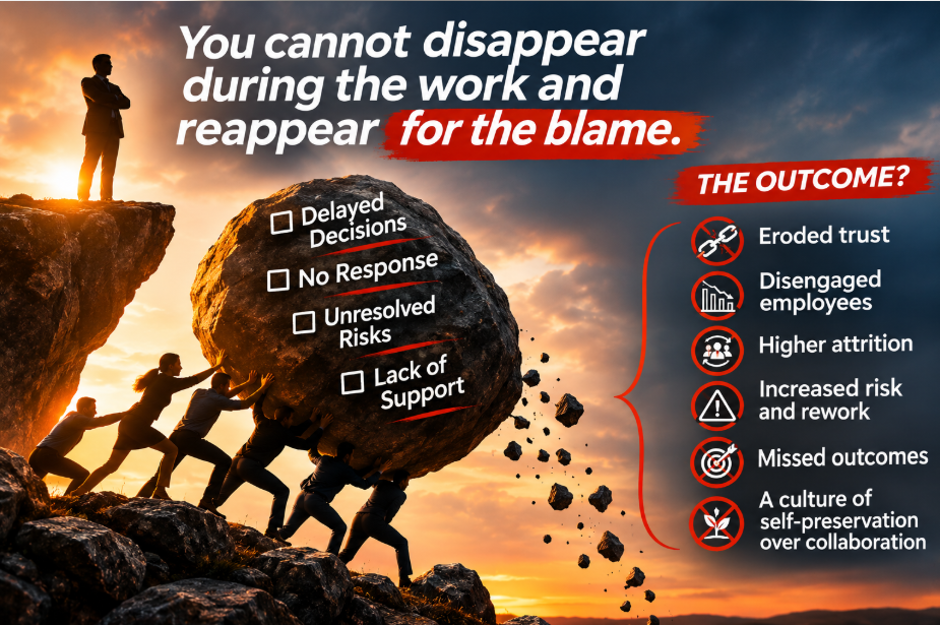
You cannot disappear during the work and reappear for the blame.
#Leadership #Accountability #OrganisationalCulture #EmployeeEngagement #PsychologicalSafety